Is Uber Eats the new savior? (Part 2)

Uber eats-Grubhub-Doordash imageIn my last post, I discussed how Uber Eats and its potential acquisition of Grubhub might just be Uber’s savior. Well, this is just off the presses…Uber has failed in its takeover attempt of Grubhub. Just this morning, Just Eat Takeaway, a Dutch company, has agreed to acquire Grubhub for $7.3 billion.

The deal values Grubhub at $75.15 per share, a 27% premium to Grubhubโ€™s closing price of $59.05. Apparently, this was one of the major roadblocks to Uber’s attempted acquisition of Grubhub. Uber was unwilling to pay the high price, and ultimately the two sides could not make a deal. Uber’s offer was closer to $70 per share, which would have valued Grubhub at about $5.9 billion.

The other major issue concerned regulatory risk, as I mentioned in part 1 of this post. Since Uber and Grubhub combined would have accounted for approx 50% of the US market, there were strong reservations about if the merger would get approval from antitrust regulators.

In a statement, an Uber spokesman said the company would continue looking for deals in the food delivery business, but would not engage in โ€œany deal, at any price, with any player.โ€ This begs the question, “what is the right deal, the right price, and the right player”? At the time of this writing, Doordash has 45% of the US market, followed by Uber Eats with approx 30%, Grubhub with approx 20%, and Postmates with approx 8%. Since Grubhub is no longer an option and a merger with Doordash seems improbable, the only remaining likely option is Postmates – probably not the ideal partner that Uber was looking for. Now instead of owning 50% of the market and being in a pole position, Uber would at best be looking at an equal footing with Doordash (see graph below).

Another equally troubling thing is that Doordash is backed by the “Bank of Softbank” which has poured huge amounts of capital that helped Doordash achieve its current market share. (Ironically, Softbank is also an investor in Uber; and investing in two competing food delivery companies is questionable strategy)

As we can see from the graph below, Uber Eats has not significantly increased its market share over the past two years, while Doordash has. And that increase coincided with Softbank’s investment in the company in 2018. As the graph also shows, Postmates’ market share decreased during the pandemic, which is troubling. At a time when food delivery businesses are doing a booming business, Postmates has lost market share. Granted, Grubhub also lost market share during this period (which may have contributed to their desire for a merger). And as you can also see from the graph, both of their losses equal Doordash’s gain.

market share of food delivery companies

In Uber’s Defense

In Uber’s defense, Just Eat Takeaway did pay a high price for the opportunity to expand to the US market. Normally, a 27% premium to the existing share price doesn’t seem too outrageous (most premiums fall within the 20-30% range). However, considering Grubhub’s declining market share (during the pandemic nonetheless), 27% does seem a bit high. Equally, if not more troubling would be the difficulty of getting the deal past the anti-trust regulators. So I can understand Uber’s not giving in and trying to negotiate a better deal.

However, Uber has been working on this year for one year, and it has to sting a little that they couldn’t get it done. For their sake, let’s hope it doesn’t turn out to be an even bigger failure and possibly even their demise in the long run.

#uber #ubereats #coronavirus #covid19 #ridesharing #businessstrategy #justeattakeaway #mergersandacquisitions #doordash #grubhub #postmates

What is your opinion? Feel free to contribute in the comments below.

Please feel free to share/repost/retweet
Is Uber Eats the new savior? (Part 1)

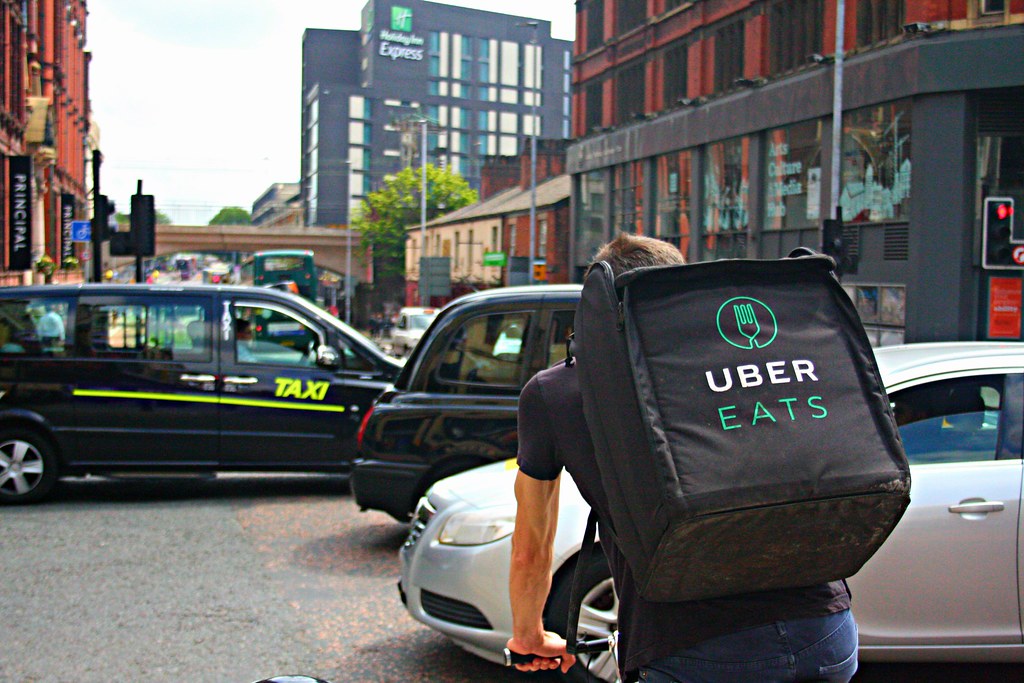
Uber Eats bicyclist

Remember when Uber was hailed as “the next Facebook”? Everybody was talking about it and how rich they were going to get from it. The TV pundits and stock market experts hyped it beyond belief, and everybody believed it.

Well, things didn’t exactly turn out that way, did they? Sure, everyone uses Uber and the company has disrupted the taxi industry and changed transportation as we know it. But honestly, Uber is a terrible business model and even worse investment.

Ever since the company went public in 2019, the share price has rarely gone above the IPO price and to say the stock has been “underperforming” is an understatement. And its business model in its current form is simply unsustainable. Due to its obsession with grabbing market share over profits, Uber is still highly unprofitable after 10 years.

Worse than that, its losses are growing at astronomical rates. In Q2 2019, Uber suffered a record $5.2 billion quarterly loss. And while $4.2 billion of that was related to expenses from its 2019 IPO, the remaining $1 billion in losses is still a 14% increase from the $878 million it lost in Q2 2018. And, while its revenues are increasing, they are not even close to catching up to its expenses. In fact, Uber loses 25 cents on every dollar it brings in and an average of $1.20 on every ride.

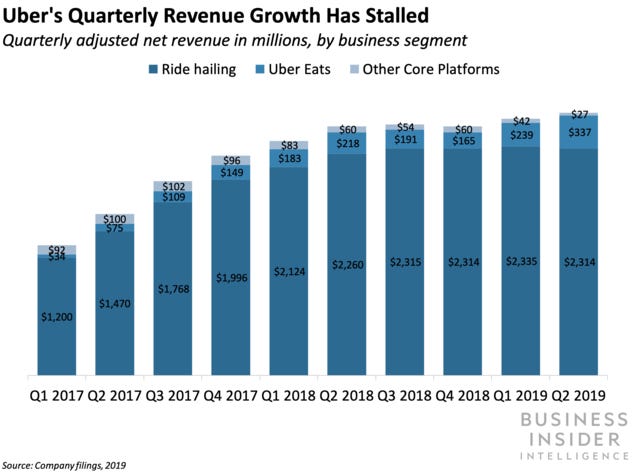
Even before coronavirus, Uber experienced its lowest-ever quarterly revenue growth in Q2 2019


Uber Eats to the Rescue

But, while it all may look like “doom and gloom” for Uber, there is a savior coming. In fact, it’s been here for awhile already โ€“ and it’s called Uber Eats.

Uber has had many “saviors” before:

First, it was Dara Khosrowshahi, who took over in 2017 after the scandal-ridden previous leadership left the company

Then, it was Softbank, leveraging their huge resources to pump $125 billion of new capital into the company later the same year

While Uber’s ride-hailing business is stuck in neutral, Uber Eats is in overdrive. Although Uber’s ride-sharing segment was hemorrhaging money in 2018 and 2019, Uber Eats saw a big jump during the same period. Actually, Uber Eats was the one lone bright spot in the company profile, growing 53% YoY and accounted for $337 million in adjusted net revenue, a record high for the segment.

Uber Eats accounted for almost 12% of Uber’s total adjusted net revenue in Q2 2019, up from just over 8% in Q2 2018

Uber Eats share of total revenue

And though still a small part of Uber’s total revenue, Uber Eats has the potential to enter more markets that its ride-hailing counterpart. Uber currently offers ride hailing in more markets than Uber Eats (71 for the former vs 47 for the latter). But Uber Eats is likely to outgrow its ride-hailing counterpart, as the food delivery segment represents a stronger long-term revenue opportunity for the company.ย 

Some countries and localities have strict regulations surrounding their taxi market, which prevents or limits competition from ride-hailing services. However, these regulations don’t lock out food delivery services like Uber Eats, enabling the company to generate revenue in markets where their core platform is restricted โ€“ a tactic the company isย pursuingย in Japan.

The Bigger Picture

Uber Eats is poised to become a bigger part of Uber’s business than its ride-hailing segment, but it will need to continue leveraging the popularity of its mobility service.

Uber’s ride-hailing app has a growing user base, and direct integration will give its Uber Eats business more exposure.ย In June 2019, Uber began toย embedย Uber Eats directly into its core app in select markets. Embedding Uber Eats in the app instead of requiring a separate app raises its profile significantly, as it places it in front of more of the company’s growing base of monthly active platform consumers (MPACs) โ€” in Q2 2019, the number of MPACs grew to 99 million, up 30% YoY, and the company stated it surpassed 100 million in July 2019.ย 

While Uber Eats faces stiff competition in the food delivery market, the wide proliferation of its core ride-hailing app could help it increase its share of sales. With Uber’s trip requests in Apr 2020 down about 80% from the previous year, it might take awhile for Uber recover on the ride hailing side. Meanwhile, the surge in food-delivery orders at Uber Eats recorded in Q1 2020 showed no signs of slowing in May, easing concerns of investors who thought it could be a one-off trend during the pandemic. And Uber Eats revenue grew 230.1 percent over the past year, with the average person spending $220.37 per year on the service.ย The only other company of the five major online food-delivery apps — Doordash, GrubHub, Postmates, Seamless, and Uber Eats — to see growth double year-over-year was Doordash, which grew by 106.4 percent. Postmates, with 41 percent growth, rounds out the top three.

Q2 2016 – Q1 2018 Revenue and User Growth Among Food Delivery Competitors

Beyond leveraging the app, Uber could also strengthen its product via an acquisition.Last week, CEO Dara Khosrowshahiย revealedย the company had considered buying rival food delivery service Caviar โ€” which was ultimatelyย acquiredย by DoorDash โ€”ย signaling the company was exploring ways to quickly grow its business.

While Khosrowshahi said Uber is unlikely to make an acquisition, we think it could become a necessity for the company, especially as the market further consolidates around it and rivals quickly gain market share.

https://www.businessinsider.com/uber-earnings-show-eats-could-be-core-business-2019-8

Fast Forward to Present Day

Although the deal with Caviar never came to fruition last year, Uber is currently negotiating an acquisition of one of its main competitors, Grubhub. Although margins are currently low in the food-delivery business, combining these two companies would cut costs and increase profitability. It would also make it the largest US food delivery service with 55% of the market, surpassing current leader Doordash. However, this proposed merger would definitely draw the intense scrutiny of anti-trust regulators.

And since news broke of Uber’s interest in Grubhub, other food-delivery companies have also been sniffing around Grubhub for a possible acquisition. Ironically, two of the publicly revealed companies (Delivery Hero and Just Eat Takeaway) are both from Europe, which may have a greater chance of consummating a deal with Grubhub due to the reduced regulatory risk. But it also drives up the bidding for Grubhub, increasing the price Uber would have to pay if it is successful. But, it seems that might be the price that Uber must pay in order to survive.

#uber #ubereats #coronavirus #covid19 #ridesharing #businessstrategy

What is your opinion? Feel free to contribute in the comments below.

Please feel free to share/repost/retweet
Why Are Targeted Ads So Effective? It’s Probably Not What You Think

behavioral targeting

Based on an article in the Harvard Business Review, studies show that targeted ads are effective not only because they are targeted, but because they also influence the target’s perception of themselves. What this means is that if the ad has been corrected targeted, the viewer is subconsciously influenced to perceive themselves as belonging to that target market segment, even if they are not fully inclusive of that segment. Studies show that they accept the fact that they have been targeted for this particular type of product as validation that they belong to the subgroup; and that this validation subsequently increased interest in the product.

Rather than target demographically, advertisers have learned that targeting behaviorally can often be more effective. However, what most advertisers don’t know is why it is more effective. They may just see that it is better at generating clicks and conversions or has higher ROI than non-behaviorally targeted ads.

We exposed students to an ad that they believed to be either behaviorally targeted or non-targeted for a high-end watch brand. Then we asked them to rate how sophisticated they perceived themselves to be. The data show that participants evaluated themselves as more sophisticated after receiving an ad that they thought was individually targeted to them, compared to when they thought the same ad was not targeted. In other words, participants saw the targeted ad as reflective of their own characteristics. The ad told them that, based on their browsing history, they had sophisticated tastes. They accepted this information, saw themselves as more sophisticated consumers, and this shift in how they saw themselves increased their interest in the sophisticated product.

Behaviorally targeted ads can also impact behaviors beyond just purchasing products. Another study was conducted in which students rated themselves as “more green” after receiving a behaviorally targeted ad for an environmentally friendly product. This resulted not only in purchases of the product, but a measured increase in the student’s willingness to donate to a pro-environmental charity, which they were prompted about at the end of the same lab session.

However, the most important part of this is that the behaviorally targeted ad must be at least somewhat plausible or accurate – meaning that the targeted individual must at least share some of the characteristics of the target segment. If the targeted individual shares none of the characteristics of the target segment, then the likelihood of a conversion is low.

*Itโ€™s important to note that the effects on self-perceptions we observed are contingent on consumers being aware that a given ad was or was not tied to their past behavior. Across all of our studies we provided participants with an explanation of behavioral targeting, so that those in the behaviorally targeted ad condition believed that they received the ad as a result of their own online behavior.

Given that the ads in our studies were not actually matched to participantsโ€™ behavior โ€” we merely created the perception that they were โ€” we expect that effects may be even stronger in the real world when behaviorally targeted ads are more accurate. If consumers are not aware that an ad has been behaviorally targeted, though, even if it is actually matched to their online actions, they likely wonโ€™t perceive the ad as a reflection of the self.

Finally, and perhaps most importantly, our results suggest that transparency benefits consumers and firms. These effects of behaviorally targeted ads only occur when consumers know that an ad has been behaviorally targeted, so it behooves advertisers to include theย AdChoices icon to clearly label behaviorally targeted ads as such. Additionally, identifying ads as behaviorally targeted gives consumers greater control over the use of their data and may help alleviate many of the privacy concerns cited by the FTC in relation to disclosure of the use of consumer data in delivering online ads.

This brings me to the point of this blog post. There is an additional method of online advertising that often incorporates behaviorally targeted ads – and that is “retargeting” (retargeting ads follow potential customers around the internet and show them targeted ads based on their previous browsing history). With retargeting ads becoming more popular with advertisers, any somewhat perceptive viewer will have noticed the same ads following them around the internet as they browse from website to website. The way retargeting works is when a visitor lands on a webpage, a javascript tag hidden in the webpage code places anonymous retargeting cookies in the visitor’s browser. This code allows advertisers who typically contract with a third-party retargeting company (such as Adroll, ReTargeter, and Criteo) to display retargeted ads to visitors as they browse other websites. The large social media platforms and browsers, such as Facebook, Google, Twitter, and Instagram even have their own retargeting services. This repeated exposure has proven to be effective not only in increasing conversions but promoting brands as well. And, when used in combination with behaviorally targeted ads, retargeting makes those ads even more effective. This combination can be a powerful 1-2 punch in the advertiser’s arsenal. For most websites, only 2% of web traffic converts on the first visit. Retargeting can multiply that conversion rate significantly, which allows advertisers to optimize their ad spend, and simultaneously increase their marketing ROI.

What is your opinion? Feel free to contribute in the comments below.

source: Harvard Business Review article

Please feel free to share/repost/retweet

Instagram vs Pinterest – Which is Better For Advertisers?

instagram vs pinterestUnless you’ve been living under a rock the past few years, you’ve probably heard of Instagram and Pinterest. Instagram is the popular image and video sharing website used by people and companies ranging from Kim Kardashian, Kylie Jenner, and Cristiano Ronaldoย to Nike, NASA, and the NBA. Pinterest is another popular image sharing (and on a smaller scale, GIFs and videos) website that users typically curate into collections around a common theme. Its three most popular users are lesser known celebrities; Joy Cho, Maryann Rizzo, and Bekka Palmer.

As of this blog post, Instagram has approximately 1 billion monthly active users (MAU) and 500 million daily active users (DAU). It’s popularity places it well ahead of other well-known social media channels, Twitter (326 million active users), Snapchat (150 million active users), and Pinterest (250 million active users). And, Instagram, which is owned by Facebook, currently accounts for approximately 25% of revenues of its parent company (next year it is projected to account for 30%).

Pinterest’s 250 million active usersย is approx 1/4 of Instagram’s. However, if your specific market is women aged 25-54, then Pinterest may be a gold mine for you. 83% of women in that age bracket in the US are on Pinterest. And, since women are often the controllers of household finances (women control 80% of household spending in the US), Pinterest has a special importance for advertisers of household products. But, that doesn’t mean men are left out either. 50% of new signups in 2018 were men. If your product has a strong international appeal, 80% of new Pinterest signups are from outside the US. High-income and educated US households are also well represented on Pinterest, and twice as likely to use the platform as low-income and less educated US households (39% of people in households worth $75k or more per year use Pinterest).

For business looking to advertise on Pinterest, the statistics reveal a powerful tool to capture sales and market share:

  • Pinterest users are twice as likely to report that they feel their time on the website was well spent (compared to other social media platforms).
  • 67% look at saved content while in stores
  • 55% use Instagram to shop
  • 98% of Pinterest users go out and try the ideas they find on the platform (compared to the average of 71% on other social media platforms)
  • 90% of weekly users use Pinterest to make purchasing decisions
  • 55% of Pinterest users are looking specifically for products
  • 85% of female users use Pinterest to plan for “life moments”

In general, Instagram tends to be more personal, with the poster sharing images and video that show the real side of your product/service and company and allow personal interaction with potential customers. Instagram users tend to add images that foster feelings ofย FOMO (otherwise known as the “fear of missing out”); which often includes the amazing food they are eating, the fabulous parties they attending, and the exotic destinations they are traveling to.

Conversely, Pinterest users often add images of future aspirations; including the clothes they want to buy, the makeup they want to test, and the kitchen remodeling projects they want to do. Pinterest users seem to be always searching for that perfect _____ (fill in the blank). Whether it’s a perfect duvet cover, kitchen accessory, wedding dress, or cufflinks, people flock to Pinterest to find it. As such, Pinterest seems to fulfill one of the basic emotional needs we all have…shopping.

Simply put, Instagram is generally more about “who you are, or what you’re doing (right now)”, whereas Pinterest is generally more about “who you want to be, or what your plans are (in the future)”.

What this means for advertisers is that Pinterest may be the better choice for marketing products or services that don’t have a built-in FOMO feature. If your product or service is something that customers have to save for, plan for, or is long-term oriented, Pinterest is probably the marketing platform for you. However, if your product or service is more short-term, perishable (in terms of longevity, not spoilage), or an impulse or emotional purchase, then Instagram may be the better platform for you.

In terms of branding, Instagram is a great tool for that purpose. It’s “in the moment” snapshots of time can be a powerful technique to reach out and connect with new audiences, or reshape a brand’s image. Instagram followers tend to seek more personal interaction and engagement with the brands they follow. If used correctly, Instagram can be very effective in promoting goods and products to potential customers. Therefore, brands must be careful to be authentic in their representation. Doing this will engender trust with users, who can also be potential advocates of the brand as influencers. In fact, some brands also choose to pay popular Instagram influencers to show their products and services in a way that feels more genuine than traditional advertising. And, some influencers get handsomely paid for doing so. In Kylie Jenner’s case, she reportedly receives $1 million per paid Instagram post. This has helped Jenner become the youngest self-made billionaire in history, coincidentally unseating the founder of Facebook, Mark Zuckerberg, for the honor. And, the paid influencer market is not going away any time soon. The total “paid influencer” market reached $1 billion in 2018, and is expected to double in 2019.ย 

Pinterest, on the other hand, seems to be the opposite of Instagram: it comes across as more natural, genuine, humble. Words that have often been used to describe Pinterest include “inspiring” and “uplifting”. This genuineness helps to create an authenticity that allows Pinterest to connect on a deeper level than most social media platforms out there. And, like Instagram, Pinterest is also a great place to get brand exposure. 97% of Pinterest searches are unbranded, and 51% of women have been exposed to new brands on Pinterest. In addition, 78% of users say content from brands on Pinterest is useful.

Whichever platform you choose depends on your advertising goals, target market, and type of product/service. Ultimately, the final decision of which one to choose should always be which generates the most traffic that produces sales, and in the end, ROI.

(all statistics from Hubspot and Pinterest)

Please feel free to share/repost/retweet