Is Uber Eats the new savior? (Part 3)

ubereats-alternatives-1587x500Let’s dive a little deeper

Due to the Coronavirus pandemic and corresponding stay-at-home orders, it should be obvious to anyone that ridesharing has pretty much halted the past few months. Going forward, unless Uber incorporates a physical barrier/screen between the driver and passenger (in the backseat), the minimum recommended distancing of 6 feet apart isn’t going to be met in a rideshare situation. And forget about Uber Pools for the time being. It will likely be a while before most people are comfortable sitting in a vehicle in close proximity to 3 other people. (I would venture that the ridership numbers for Uber Pools will suffer worse than Uber X rides during the Covid period.) Basically, the pandemic has effectively cratered Uber’s rideshare business for the foreseeable future.

The ride-share segment was down 80% and reported a $2.9 billion loss in Q1 2020, it’s largest loss in three quarters.
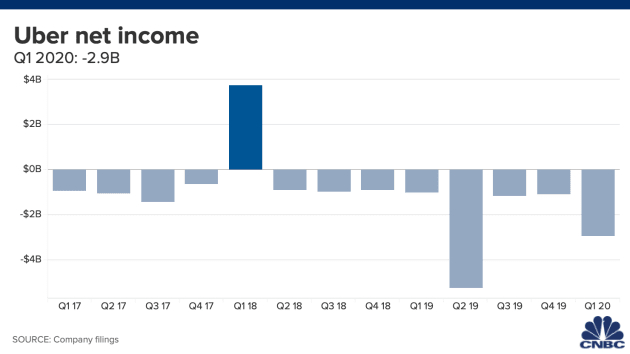
Uber net income

Other Issues

During the pandemic, Uber laid off 3700 full-time employees (14% of its workforce) and another 400 employees from its bike and scooter division, Jump, as part of an investment deal offloading that business to Lime.

And Uber is also dealing with a new lawsuit in California that claims Uber wrongfully classified drivers as contractors rather than employees to avoid paying for overtime, reimbursement for business-related expenses, access to unemployment and disability insurance, paid sick leave, and other benefits.

Given the massive losses that Uber has sustained since its inception from its ride-sharing segment and the promising growth of the food-delivery segment as discussed in part 1 of this post, pushing its food delivery business might seem like the logical way forward to eventual profitability. After all, Uber Eats reported adjusted net revenue of $1.4 billion in 2019, an increase of 82% over the previous year.

However, those numbers don’t accurately reflect the real impact of the business’s growth on Uber, and when you take a deeper look into the food delivery business, you see that the economics make it difficult to see a long term path to profitability.

During the same period that Uber reported the adjusted net revenue of $1.4 billion, it also reported EBITDA of -$461 million​. Much of this loss came from “increased investments in key markets that delivered category position improvement.” You’re probably asking, what does that mean exactly? It means that Uber spent 45% of its revenues ($1.13 billion) on “excess driver incentives”. Again, you’re probably wondering, well what does that mean?

“Excess driver incentives” is the term Uber uses to describe two things, either paid new driver referrals (usually from an existing driver) or financial losses on rides and deliveries. Also mentioned in part 1 of this post, Uber has been very aggressive in grabbing market share in some areas, much to the detriment of its bottom line. In order to get drivers on board and lower prices as much as possible, Uber essentially loses money on every ride. And since it pays the driver more than it collects in revenue, it chalks it up to a cost of doing business to gaining dominant market share. While this has worked well to some degree so far, it is unsustainable in the long run.

This is why Uber purposely breaks out what it pays drivers in excess incentives so that it can easily show investors what the impact on profit would be if it eliminated these incentives. And if it’s not clear by now, the plan is to certainly eliminate this expense as much as possible in order to become profitable.

So about that “Uber Eats savior thing” again…

Even as Uber Eats seems to be a path forward for Uber to gain profitability, it is a road littered with obstacles and fraught with dangers. Food delivery companies basically earn money from delivery fees and revenue share with restaurants. And to sign up some bigger restaurant chains, the food delivery companies have had to lower their commissions. On top of that, several cities have now started capping the fees they can charge restaurants. Seattle, San Francisco, Washington D.C., and Jersey City have all instituted some sort of cap on delivery fees with other cities expected to follow suit. Other cities such as Chicago have forced the companies to reveal what exactly constitutes the total delivery fee by itemizing everything including the actual delivery costs, taxes, food costs, and the commissions and service fees restaurants pay.

All of these factors contribute to a murky outlook for Uber’s future. While it still continues growing, its profitability will continue to be a big question mark.

But, there are solutions

Recent polling data suggests that somewhere between 13 and 20 percent of folks in the U.S. say that they’ll start venturing back out once their regional shutdowns are lifted, and about half, CBS News reports, say they won’t resume normal social activity until it’s clear the outbreak is over. If those numbers are accurate, Uber’s Rides’ business is likely down for the long haul, Eats will continue to shine, and Uber will be best served by going where the money is: food delivery.

Consolidation is the way forward in the food-delivery business, and Uber understands that very clearly. As part of the quote mentioned in part 2 of this post, Uber stated “like ridesharing, the food delivery industry will need consolidation in order to reach its full potential for consumers and restaurants”. I’m just wondering if they just lost their best potential partner (Grubhub) and may now have to settle for the leftovers (Postmates). Despite that, look for a merger with Postmates in the coming months.

In my opinion, Uber Eats might just be the new savior…and possibly the only one for Uber.

#uber #ubereats #coronavirus #covid19 #ridesharing #businessstrategy #justeattakeaway #mergersandacquisitions #doordash #grubhub #postmates

What is your opinion? Feel free to contribute in the comments below.

Please feel free to share/repost/retweet

Is Uber Eats the new savior? (Part 2)

Uber eats-Grubhub-Doordash imageIn my last post, I discussed how Uber Eats and its potential acquisition of Grubhub might just be Uber’s savior. Well, this is just off the presses…Uber has failed in its takeover attempt of Grubhub. Just this morning, Just Eat Takeaway, a Dutch company, has agreed to acquire Grubhub for $7.3 billion.
The deal values Grubhub at $75.15 per share, a 27% premium to Grubhub’s closing price of $59.05. Apparently, this was one of the major roadblocks to Uber’s attempted acquisition of Grubhub. Uber was unwilling to pay the high price, and ultimately the two sides could not make a deal. Uber’s offer was closer to $70 per share, which would have valued Grubhub at about $5.9 billion.

The other major issue concerned regulatory risk, as I mentioned in part 1 of this post. Since Uber and Grubhub combined would have accounted for approx 50% of the US market, there were strong reservations about if the merger would get approval from antitrust regulators.

In a statement, an Uber spokesman said the company would continue looking for deals in the food delivery business, but would not engage in “any deal, at any price, with any player.” This begs the question, “what is the right deal, the right price, and the right player”? At the time of this writing, Doordash has 45% of the US market, followed by Uber Eats with approx 30%, Grubhub with approx 20%, and Postmates with approx 8%. Since Grubhub is no longer an option and a merger with Doordash seems improbable, the only remaining likely option is Postmates – probably not the ideal partner that Uber was looking for. Now instead of owning 50% of the market and being in a pole position, Uber would at best be looking at an equal footing with Doordash (see graph below).

Another equally troubling thing is that Doordash is backed by the “Bank of Softbank” which has poured huge amounts of capital that helped Doordash achieve its current market share. (Ironically, Softbank is also an investor in Uber; and investing in two competing food delivery companies is questionable strategy)

As we can see from the graph below, Uber Eats has not significantly increased its market share over the past two years, while Doordash has. And that increase coincided with Softbank’s investment in the company in 2018. As the graph also shows, Postmates’ market share decreased during the pandemic, which is troubling. At a time when food delivery businesses are doing a booming business, Postmates has lost market share. Granted, Grubhub also lost market share during this period (which may have contributed to their desire for a merger). And as you can also see from the graph, both of their losses equal Doordash’s gain.

market share of food delivery companies

In Uber’s Defense

In Uber’s defense, Just Eat Takeaway did pay a high price for the opportunity to expand to the US market. Normally, a 27% premium to the existing share price doesn’t seem too outrageous (most premiums fall within the 20-30% range). However, considering Grubhub’s declining market share (during the pandemic nonetheless), 27% does seem a bit high. Equally, if not more troubling would be the difficulty of getting the deal past the anti-trust regulators. So I can understand Uber’s not giving in and trying to negotiate a better deal.

However, Uber has been working on this year for one year, and it has to sting a little that they couldn’t get it done. For their sake, let’s hope it doesn’t turn out to be an even bigger failure and possibly even their demise in the long run.

#uber #ubereats #coronavirus #covid19 #ridesharing #businessstrategy #justeattakeaway #mergersandacquisitions #doordash #grubhub #postmates

What is your opinion? Feel free to contribute in the comments below.

Please feel free to share/repost/retweet

Is Uber Eats the new savior? (Part 1)

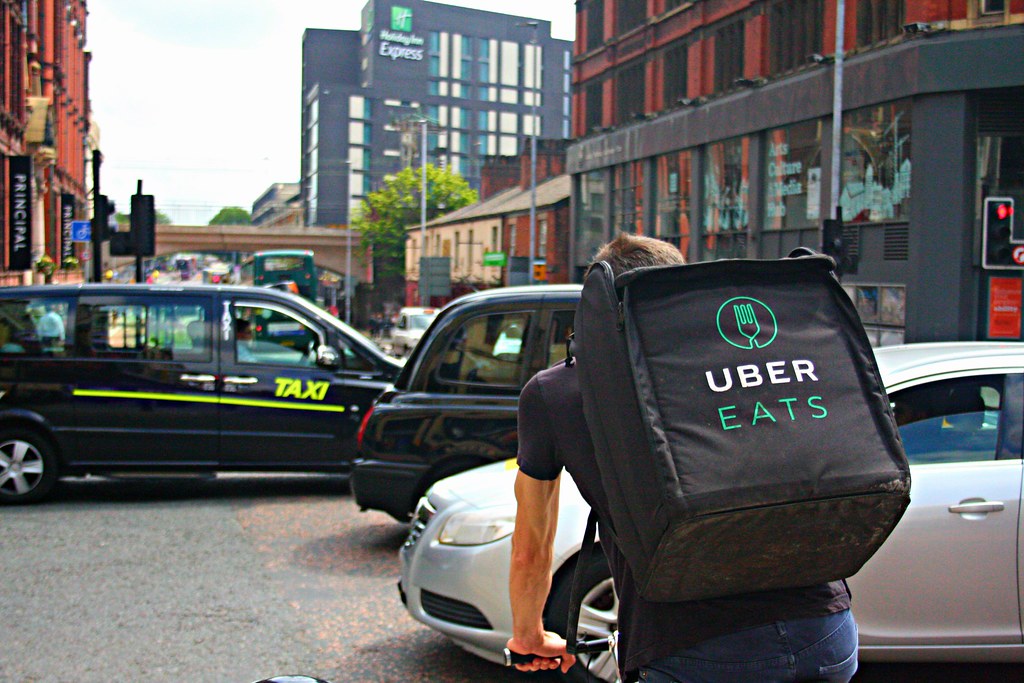
Uber Eats bicyclist

Remember when Uber was hailed as “the next Facebook”? Everybody was talking about it and how rich they were going to get from it. The TV pundits and stock market experts hyped it beyond belief, and everybody believed it.

Well, things didn’t exactly turn out that way, did they? Sure, everyone uses Uber and the company has disrupted the taxi industry and changed transportation as we know it. But honestly, Uber is a terrible business model and even worse investment.

Ever since the company went public in 2019, the share price has rarely gone above the IPO price and to say the stock has been “underperforming” is an understatement. And its business model in its current form is simply unsustainable. Due to its obsession with grabbing market share over profits, Uber is still highly unprofitable after 10 years.

Worse than that, its losses are growing at astronomical rates. In Q2 2019, Uber suffered a record $5.2 billion quarterly loss. And while $4.2 billion of that was related to expenses from its 2019 IPO, the remaining $1 billion in losses is still a 14% increase from the $878 million it lost in Q2 2018. And, while its revenues are increasing, they are not even close to catching up to its expenses. In fact, Uber loses 25 cents on every dollar it brings in and an average of $1.20 on every ride.

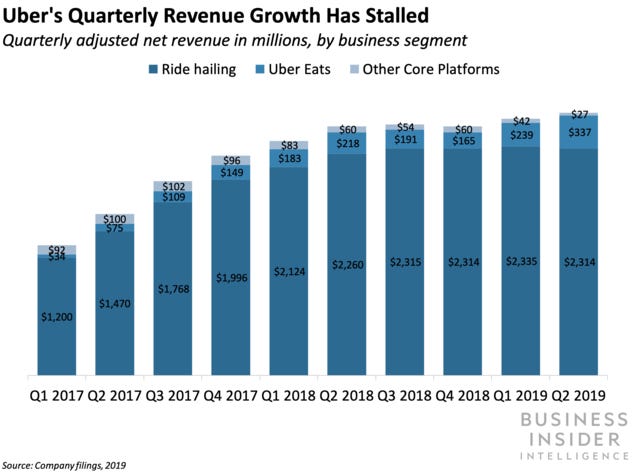
Even before coronavirus, Uber experienced its lowest-ever quarterly revenue growth in Q2 2019


Uber Eats to the Rescue

But, while it all may look like “doom and gloom” for Uber, there is a savior coming. In fact, it’s been here for awhile already – and it’s called Uber Eats.

Uber has had many “saviors” before:

First, it was Dara Khosrowshahi, who took over in 2017 after the scandal-ridden previous leadership left the company

Then, it was Softbank, leveraging their huge resources to pump $125 billion of new capital into the company later the same year

While Uber’s ride-hailing business is stuck in neutral, Uber Eats is in overdrive. Although Uber’s ride-sharing segment was hemorrhaging money in 2018 and 2019, Uber Eats saw a big jump during the same period. Actually, Uber Eats was the one lone bright spot in the company profile, growing 53% YoY and accounted for $337 million in adjusted net revenue, a record high for the segment.

Uber Eats accounted for almost 12% of Uber’s total adjusted net revenue in Q2 2019, up from just over 8% in Q2 2018

Uber Eats share of total revenue

And though still a small part of Uber’s total revenue, Uber Eats has the potential to enter more markets that its ride-hailing counterpart. Uber currently offers ride hailing in more markets than Uber Eats (71 for the former vs 47 for the latter). But Uber Eats is likely to outgrow its ride-hailing counterpart, as the food delivery segment represents a stronger long-term revenue opportunity for the company

Some countries and localities have strict regulations surrounding their taxi market, which prevents or limits competition from ride-hailing services. However, these regulations don’t lock out food delivery services like Uber Eats, enabling the company to generate revenue in markets where their core platform is restricted – a tactic the company is pursuing in Japan.

The Bigger Picture

Uber Eats is poised to become a bigger part of Uber’s business than its ride-hailing segment, but it will need to continue leveraging the popularity of its mobility service.

Uber’s ride-hailing app has a growing user base, and direct integration will give its Uber Eats business more exposure. In June 2019, Uber began to embed Uber Eats directly into its core app in select markets. Embedding Uber Eats in the app instead of requiring a separate app raises its profile significantly, as it places it in front of more of the company’s growing base of monthly active platform consumers (MPACs) — in Q2 2019, the number of MPACs grew to 99 million, up 30% YoY, and the company stated it surpassed 100 million in July 2019. 

While Uber Eats faces stiff competition in the food delivery market, the wide proliferation of its core ride-hailing app could help it increase its share of sales. With Uber’s trip requests in Apr 2020 down about 80% from the previous year, it might take awhile for Uber recover on the ride hailing side. Meanwhile, the surge in food-delivery orders at Uber Eats recorded in Q1 2020 showed no signs of slowing in May, easing concerns of investors who thought it could be a one-off trend during the pandemic. And Uber Eats revenue grew 230.1 percent over the past year, with the average person spending $220.37 per year on the service. The only other company of the five major online food-delivery apps — Doordash, GrubHub, Postmates, Seamless, and Uber Eats — to see growth double year-over-year was Doordash, which grew by 106.4 percent. Postmates, with 41 percent growth, rounds out the top three.

Q2 2016 – Q1 2018 Revenue and User Growth Among Food Delivery Competitors

Beyond leveraging the app, Uber could also strengthen its product via an acquisition.Last week, CEO Dara Khosrowshahi revealed the company had considered buying rival food delivery service Caviar — which was ultimately acquired by DoorDash — signaling the company was exploring ways to quickly grow its business.

While Khosrowshahi said Uber is unlikely to make an acquisition, we think it could become a necessity for the company, especially as the market further consolidates around it and rivals quickly gain market share.

https://www.businessinsider.com/uber-earnings-show-eats-could-be-core-business-2019-8

Fast Forward to Present Day

Although the deal with Caviar never came to fruition last year, Uber is currently negotiating an acquisition of one of its main competitors, Grubhub. Although margins are currently low in the food-delivery business, combining these two companies would cut costs and increase profitability. It would also make it the largest US food delivery service with 55% of the market, surpassing current leader Doordash. However, this proposed merger would definitely draw the intense scrutiny of anti-trust regulators.

And since news broke of Uber’s interest in Grubhub, other food-delivery companies have also been sniffing around Grubhub for a possible acquisition. Ironically, two of the publicly revealed companies (Delivery Hero and Just Eat Takeaway) are both from Europe, which may have a greater chance of consummating a deal with Grubhub due to the reduced regulatory risk. But it also drives up the bidding for Grubhub, increasing the price Uber would have to pay if it is successful. But, it seems that might be the price that Uber must pay in order to survive.

#uber #ubereats #coronavirus #covid19 #ridesharing #businessstrategy

What is your opinion? Feel free to contribute in the comments below.

Please feel free to share/repost/retweet

I’m proud to be accepted to GoingVC’s Cohort 6

Proud to be part of GoingVC’s Cohort 6, and grateful for the opportunity to make a positive impact in venture capital.

*One of the most amazing things about this group of people is the diverse backgrounds we all come from. I look forward to learning and sharing knowledge with all of them.

#venturecapital #goingvc #cohort #venture #vc #venturecapitalists